
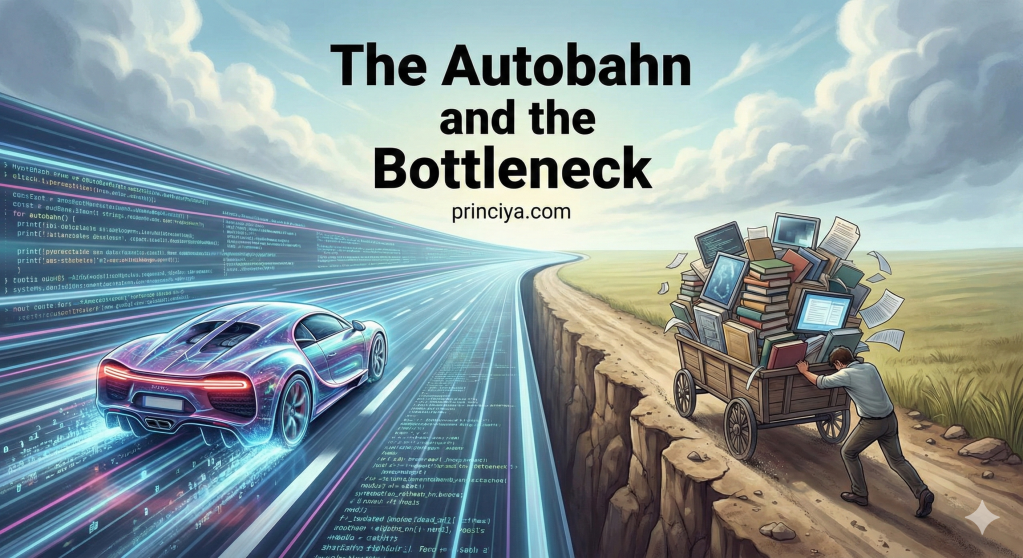
I have always been a builder at heart. Consequently, I am thoroughly enjoying the leverage I now possess. It feels like a genuine superpower to have an idea in the morning and see it go live by the afternoon. To see multiple side projects running in parallel, replacing paid SaaS subscriptions with my own utility tools built on top of LLM APIs is intoxicating.
But as I navigate this new reality, I’m realizing that while the engines have gotten faster, the roads haven’t changed.
The Fatigue of Infinite Context
I pride myself on having a good memory and strong organizational skills. These traits are coming in super handy right now, allowing me to cut through the noise and recall the right context from the massive chaos of information.
However, I’ve been deliberately reflecting on my behaviors lately, and I’ve noticed a new phenomenon. Let’s call it AI Burnout.
I am getting more output in less time. More tasks are getting checked off. But the mental toll is real. I find myself getting distracted, eager to see what the “other agent” will do, getting stuck in the loop of “just one more prompt” to push a task to the next stage. It turns out that while AI allows for infinite context switching, the human brain still pays a tax for every switch. I am finishing the day successfully, but drained. I am learning that I need to contain that excitement; just because I can do everything at once, doesn’t mean I should.
The IC is now a Manager
At work, the dynamic is shifting. I previously wrote that AI is not a crisis, and I stand by that. But it is a massive restructuring of skills.
We are moving toward a reality where Individual Contributors (ICs) at all levels need management skills. Work is becoming less about syntax and more about orchestration. You are talking to various agents, deciding when to give them the freedom to explore and when to micromanage them before they go rogue.
It validates a theory I have always held: it all starts and ends with people and communication.
Prompting is just communication. It is context awareness. If you didn’t practice prompting last year, you are likely already behind on the curve. We effectively need a “Management 101” course for everyone, because we are all managing digital teams now.
Building the Autobahn
This leads me to the biggest missing piece: Infrastructure.
We are trying to solve problems with more speed, but we aren’t looking at the grassroots. Think of how Germany built the Autobahn. They built the infrastructure to support the speed of the cars. Right now, in the AI space, it feels like we have been gifted cars with turbo-boost engines, but the roads have become narrower.
AI is an amplifier. But for it to work, people need a 10x ability to read, parse, and synthesize knowledge. Code generation and content creation have become cheap and mass-adopted, causing consumption requirements to skyrocket.
We are focused on the output, but our personal infrastructure needs to evolve. We need “System Design for Humans”. The ability to set the right context and ask the right questions to get the right solution.
Without widening the road, all this horsepower just leads to congestion.
We need to solve this from the ground up.




 Princiya Sequeira
Leave a comment