
AI adoption within the tech industry feels like waking up every day to an avalanche of new, machine-generated code. In my previous posts, I talked about the Autobahn. The personal infrastructure we all need to build to level up and sustain this relentless pace of AI learning.
I’ve also touched on the evolution of the IC (Individual Contributor). What used to be a distinct transition from IC to Management is now a reality everyone has to face, regardless of title. Today’s ICs must get comfortable with AI writing the majority of the code. We have to learn when to step in, when to let loose, and hardest of all how to trust agents that might actually do a better job than us.
In the end, we have to accept that it is normal not to write much code anymore. Instead, our job is teaching agents how to write it on our behalf. When this happens, the mindset shifts to: how much more code can you orchestrate your agents to write? All of this indicates that there are plenty of new problems to solve. At the very least, we shouldn’t be worrying about losing our jobs.
AI is the City
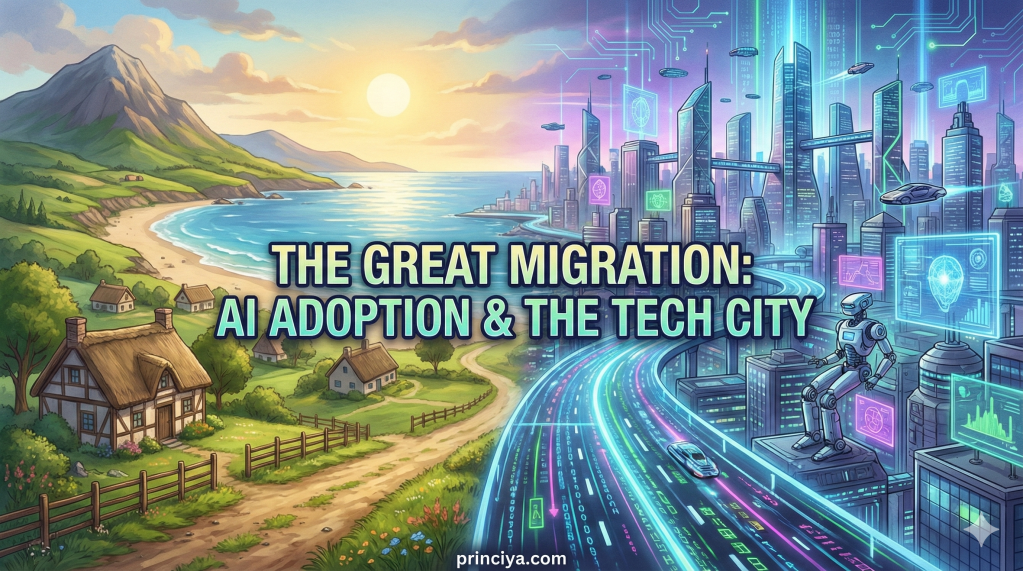
But this morning, a new thought struck me. This whole shift? It feels exactly like humanity’s historical migration from village life to city life.
For centuries, people lived in villages. Life was slower, grounded, and intensely physical. When you wrote code in the pre-AI era, you built it by hand. It was a local craft. It had a signature, and you could practically feel the author’s intent in the syntax. We were artisans.
Then came the city. Dense, loud, fast, industrial, and optimized. The shift wasn’t optional; it was a structural change to how society operated.
AI is our city. We’ve moved away from handwritten, manual labor and into mass production. The output scales, the convenience increases, and efficiency explodes. But just like the early industrial cities, something is lost in the transaction. The work can feel synthetic.
The Need for a Coding Gym
Think about physical labor. In a village, plowing a field, carrying water, and building with your hands naturally kept you fit. But in a city, machines do the heavy lifting. Convenience increases, but our bodies stop moving the way they used to. So, what did city dwellers do? They invented the gym. They had to manufacture physical strain because life no longer provided it naturally.
Engineering is facing the exact same dilemma. AI is doing the heavy lifting now. We are no longer plowing the fields; we are supervising the machinery. We prompt, we review, we steer.
Because of this, we are going to need a coding gym. Engineers will need to actively practice blind coding sessions, whiteboard-only system design, and raw debugging without autocomplete. We need constraint-based exercises without AI. Not because AI is bad, but because unused muscles atrophy. If we don’t intentionally practice, we will lose our pattern recognition, our debugging stamina, and our ability to mentally simulate complex systems.
The Universal Manager
This urbanization of engineering has fundamentally changed career trajectories. It used to be that transitioning from an Individual Contributor (IC) to a Manager meant writing less code, delegating more, and multiplying your output through others.
Today, every IC is going through this transition.
Even if you are the only human on the project, you are managing a team of agents. You have to teach them, correct them, decide when to trust them, and know when to override them.
The metric for success is no longer, “How much code did you write?” It’s now, “How much high-quality code did your agents produce under your direction?”
This isn’t job loss. It’s role evolution. We are transitioning from artisans to architects.
Surviving the Smog
Of course, city life isn’t perfect. It brought pollution, artificial food, and a fast-paced environment that often lacks presence.
AI carries a similar risk of psychological pollution. There is a looming sense of artificiality. Content feels synthetic, and output is abundant but detached. Laziness is a real risk. If we rely on the machines too heavily without understanding the underlying mechanics, it leads to shallow thinking, over-trusted outputs, and architectural fragility.
But remember: cities didn’t disappear because of pollution. They evolved. They introduced zoning laws, sanitation systems, and green spaces.
Right now, in the AI era, we are in the storming phase. It’s all noise, hype, fear, layoff headlines, and flashy agent demos. But soon, we will norm. Standards will emerge. We will build the necessary infrastructure: agent governance, review frameworks, prompt discipline, and strict quality gates. Then, we will perform.
The Quiet Village
After years of the fast city life, people naturally crave the quiet. They want the slowness of the mountains or the sea. If I could, I would always go back to a big farm, with mountains on one side and the sea on the other. I grew up by the beach, and I can stare at the water all day. It resets something deep inside me.
That longing doesn’t mean the city failed; it just means humans require balance. In this AI-saturated world, we will increasingly crave deep thinking, handwritten logic, first-principles reasoning, and quiet creation. The solution isn’t abandoning AI. It’s knowing when to walk to the shore.
AI is not removing our problems; it’s just creating new categories of them. Village life didn’t need urban architecture, but city life demands it. The people who build the roads, the sanitation, and the zoning for this new AI city are the ones who will define the next decade.
Build your Autobahn. Navigate the city. Just don’t forget to visit the village once in a while.


 Princiya Sequeira
Leave a comment