
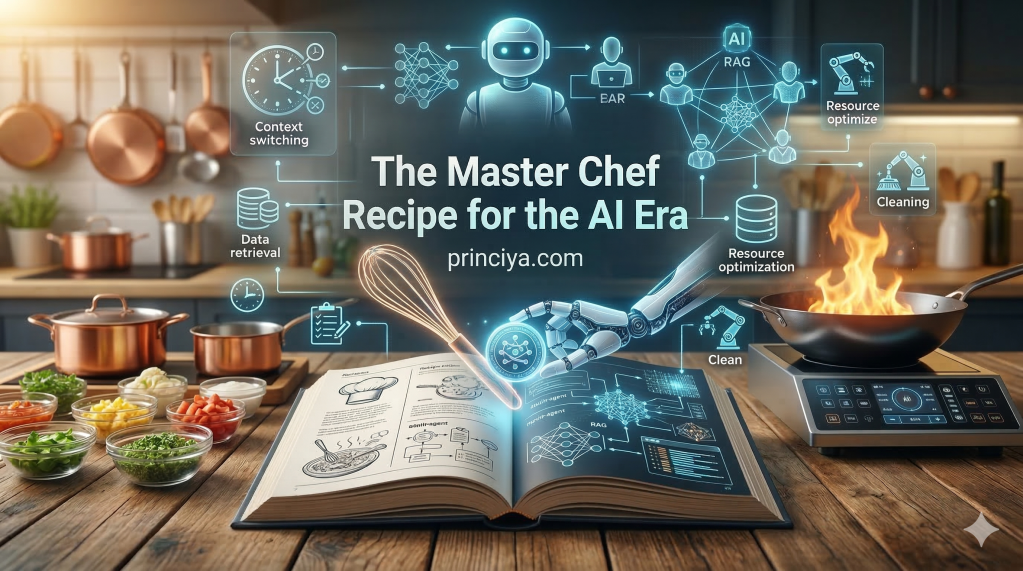
TL;DR: The secret to leading in the AI era and building robust agentic solutions isn’t just about understanding the technology. It’s about orchestration, seamless context-switching, and efficient resource management skills I was surprised to find perfectly mirrored in my ability to execute a complex cooking marathon.
I have a skill that I don’t talk about often, but one I am incredibly proud of: I am exceptionally organized when it comes to cooking.
Over the years, I have stress-tested this ability. I can cook multiple items at an amazing speed, maintaining a high standard without letting the chaos of the kitchen overwhelm me. Today, during a particularly intense cooking marathon, I took a step back to observe why this works so well for me.
I realized that my efficiency isn’t just about chopping fast. It’s about the ability to context-switch flawlessly in my head. I know exactly which dish needs what ingredient at what precise moment. I can orchestrate the recipes, optimize the pre-prep work, and strategically share resources like vessels and cutlery across different dishes. And perhaps most importantly, I clean as I go. By the time the food is ready, the kitchen is clear, and the mess is gone.
As I was wiping down the counter today, it struck me: the mental bandwidth required to orchestrate a complex meal is exactly the kind of clarity we need to lead in the AI era. Furthermore, the mechanics of a highly functional kitchen are a perfect blueprint for creating effective agentic AI solutions.
If we want to build autonomous AI systems that actually work, we can hand-pick a few profound lessons from the culinary arts.
1. Masterful Context-Switching (The Multi-Agent Orchestrator)
In the kitchen, I have a mental map of boiling water, sautéing onions, and resting dough. I switch between these contexts without losing the plot.
In the AI space, an effective agentic solution relies on a master orchestrator. A single LLM can’t do everything well at once. The future belongs to multi-agent frameworks where a routing agent seamlessly context-switches, delegating specific tasks (research, coding, data analysis) to specialized sub-agents. The success of the system depends entirely on how well the orchestrator manages these hand-offs without dropping the ball.
2. Optimizing Pre-Prep (Data Readiness & RAG)
Before a pan ever gets hot, the ingredients need to be prepped. If I stop to chop garlic while the oil is burning, the dish fails.
Similarly, AI agents are only as good as the context they are fed. In the AI era, pre-prep is your data infrastructure and Retrieval-Augmented Generation (RAG) pipelines. If an agent has to struggle to find messy, unstructured data in real-time, the latency spikes and the output degrades. Doing the pre-prep, i.e. structuring your data and defining clear system prompts is what enables the agent to operate at cooking speed.
3. Shared Vessels and Cutlery (Resource & Tool Optimization)
I don’t use a different cutting board for every single vegetable, and I reuse pans strategically to layer flavors and save time.
Agentic systems need to share resources efficiently, too. Instead of spinning up isolated environments for every task, smart agent architectures share context windows, memory banks, and external tools (like calculators or web search APIs). Knowing when agents should share a vessel (a shared memory state) versus when they need their own isolated workspace is key to optimizing compute and cost.
4. Cleaning the Mess (Context Window Management)
This is my favorite parallel. If I let pots and peels pile up, my cooking speed drastically drops because I have no room to work. I have to clean the mess as I go.
In LLMs, the mess is an overloaded context window. If you feed an agent an endless, uncurated thread of past conversational garbage, it begins to hallucinate, forget instructions, and slow down. Effective agentic solutions require a clean-as-you-go mechanism, summarizing past turns, discarding irrelevant tokens, and keeping the active memory clean and focused.
The Bandwidth to Lead
Leading with clarity in the AI era means cutting through the hype and noise. It requires the same mental reset and focus I’ve written about previously when discussing burnout and building daily writing habits.
When you have a system whether it’s for writing every day, cooking a feast, or deploying AI, you free up your mental bandwidth. You stop reacting to the fire in the pan and start orchestrating the entire kitchen.
We don’t need to overcomplicate the future of AI. Sometimes, the best architectural frameworks are hiding in plain sight, right there on the kitchen counter.


 Princiya Sequeira
Leave a comment