
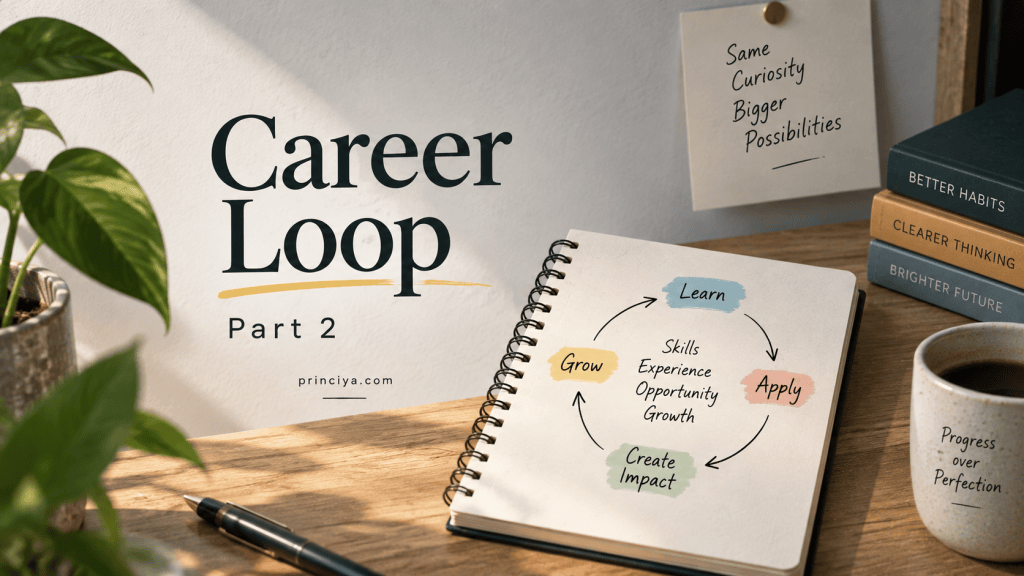
In the previous post, I wrote about my career transition and the moment I had to go through a shift to adapt to the next phase. Read Part 1 of this post here. In this post, I continue on my career transition and navigating through the AI phase.
Starting again from zero
The interesting thing about career growth is that every new role humbles you. You may carry experience with you, but trust does not fully transfer. At a new company, I had management experience, but I still had to prove myself in that specific context. New people. New culture. New business model. New expectations. New hidden rules.
This is where many people get frustrated.
- “I have done this before.”
- “I already know how to manage.”
- “Why do I need to prove myself again?”
But every organization asks a slightly different question before giving you more scope. Can we trust you here? Not in theory. Not based on your previous title. Here!
So I had to repeat the loop.
Do the current job well. Understand what matters. Build trust. Find the painful problems. Help with those problems. Create visible outcomes.
Within a year, I was promoted to Senior Engineering Manager.
The promotion mattered, of course. But what mattered more was the pattern behind it. I was not only doing the role I was hired for. I was helping with the enterprise sales side of engineering, where technical leadership, customer context, business urgency, and people coordination had to come together.
That kind of work does not always fit neatly into a job description. But careers often grow in the space between the job description and the real business need.
Then AI changed the room
Four years later, I joined another company as a Senior Engineering Manager. This time, the industry itself was shifting. AI was no longer a side conversation. It was entering product roadmaps, engineering workflows, leadership discussions, hiring expectations, and almost every conversation about productivity.
I knew the CTO already, which helped. But knowing someone does not remove the need to create trust in a new environment. Also, the AI era created a different kind of leadership challenge. It was not enough to say, “Let us use AI tools.” The harder questions were human questions.
- How do we help teams adopt AI without making them feel replaced?
- How do we create space for experimentation without turning everything into chaos?
- How do we move fast without pretending every demo is a strategy?
- How do we connect AI work to actual business value?
- How do we help engineers, product teams, and leaders build confidence together?
This is where the people management side of my job became very important. I started looking for the places where AI could reduce friction, speed up delivery, and help teams release new things faster. I worked on internal AI platform efforts, workflow automation, company wide AI hackathons, and AI adoption at scale.
And slowly, the work became visible. Within a few months, I had the CEO’s attention. Not because I had all the answers. I did not. But because I was trying to connect the pieces.
- The technology.
- The people.
- The business outcome.
- The fear.
- The curiosity.
- The delivery pressure.
- The leadership responsibility.
That is the part of AI adoption I keep coming back to. AI change is not only a tooling problem. It is a leadership problem. And leadership, in moments of change, is not about sounding the smartest in the room. It is about helping the room move.
The loop is not a hack
I am careful with career frameworks because they can sometimes make growth sound too mechanical. Real life is messier than that.
Sometimes you ask for growth and the timing is wrong.
Sometimes you do the work and the company does not see it.
Sometimes your manager wants to help but does not have the power.
Sometimes you are tired.
Sometimes you are still becoming the person required for the next role.
But I do believe there is something powerful in the idea of building an explicit win/win relationship with your manager or leaders.
Not performative alignment.
Not managing up as politics.
Not pretending your ambition is selfless.
A real partnership. “I want to grow. I also want to help. Where do those two things meet?” That question has shaped a lot of my career.
It helped me move from frontend engineering to DevOps to management. It helped me start again in a new company and grow into Senior EM scope. It is helping me now as I lead AI initiatives in a time when everyone is trying to understand what this new era means.
What I understand now
I used to think career growth was about being ready. Now I think it is also about being in conversation.
- With your manager.
- With the business.
- With the team.
- With the moment you are in.
- With the version of yourself that is ready for more, even if not fully comfortable yet.
Good work still matters. It is the foundation. Without it, ambition has no weight. But good work alone is not the whole story. You have to make your ambition visible. You have to understand what the organization needs. You have to find the overlap. You have to deliver there. You have to let the trust from one loop create the next one.
That is the part I did not know I was doing all along. I was not climbing a ladder. I was learning how to build trust, create value, and grow in public enough for the next door to open.



Leave a Reply