
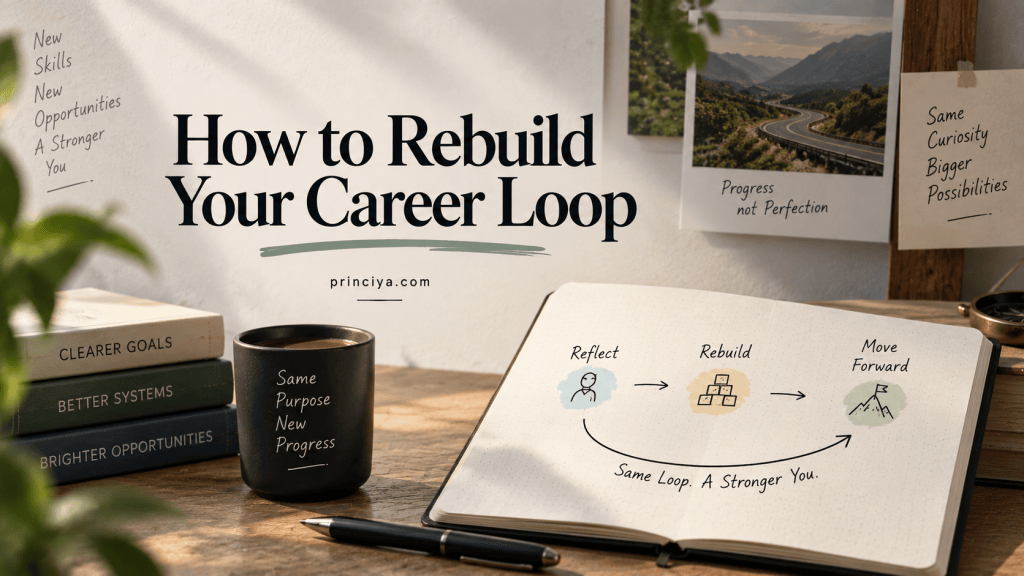
Read similar posts related to my career transition and career loop here.
One of the most brutal lessons in a senior career is accepting that merit and advancement are related, but they are absolutely not the same thing. Merit is your capability, your judgment, your impact. Advancement is a game of organizational bingo: does the company have the right role, sponsor, budget, timing, and alignment to actually reward that merit?
You can be entirely ready for the next level before your company is. You can have the total trust of your engineering or product teams, but lose your executive sponsor because of a sudden re-org. You can be doing undeniably vital work, only to find the company’s strategy has shifted to a different product line.
I don’t say this to make you bitter. I say this to give you clarity.
Without this clarity, high performers stick around way too long in toxic or stagnant environments that slowly warp their professional self-worth. You start to confuse a lack of upward movement with a lack of personal value. You start trying to patch over deep organizational dysfunction with your own invisible labor, patience, and misplaced loyalty.
Eventually, you have to stop asking: “What else do I have to prove here?” And start asking: “What environment is actually ready for what I already know how to do?”
The Leadership Maturity of Moving On
People love to frame moving on as giving up. But often, walking away is the most strategic, high-leverage leadership decision you can make.
It doesn’t have to be an emotional table-flip. It can just be a rational audit: the environment changed, the priorities shifted, the path disappeared. You are carrying a heavy load, but you are no longer growing from it.
Staying in that scenario might look like loyalty from the outside, but it is incredibly expensive on the inside. It costs you your momentum. It costs you your confidence. Leaving doesn’t mean your work there was wasted. That grind built your judgment, expanded your range, and taught you exactly what kind of organizational readiness you need for your next act.
Take the learning, reset the context, and run the loop somewhere else.
Rebuilding the Loop
When you drop into a new organization, your past experience gives you a head start, but it doesn’t bypass the need to earn it all over again. Even if you were brought in by a senior leader you know, trust with one person doesn’t scale to trust across a whole system.
You have to restart the loop:
- Nail your core job first.
- Figure out what the business actually cares about right now.
- Build credibility with the people on the ground.
- Find the painful, high-impact problems no one wants to touch.
- Own the gaps and ship visible outcomes.
- Use those wins to expand your territory.
If you look at the current AI era, this loop is playing out in real-time. Every company is scrambling to adopt AI, but the real bottleneck isn’t technical, it’s organizational. Teams need new tooling, sure, but mostly they need psychological safety. They need leaders who can cut through the hype, reduce fear, and bridge the massive gap between executive urgency and team-level reality.
The best AI transformation work right now is pure change management. It’s helping teams safely experiment, automate the right mundane workflows, and tie those experiments back to actual business value. At a senior level, leadership isn’t about having the smartest answer; it’s about creating the exact conditions your organization needs to get out of its own way.
The Real Formula
“Do excellent work and everything else will follow” is a comforting lie. Excellent work is the baseline. The full reality of senior growth looks more like this:
- Do exceptional work.
- Make your ambition known.
- Build deep trust with stakeholders.
- Find the exact overlap between your personal growth and the organization’s deepest pain points.
- Deliver outsized value there.
- Actively secure sponsorship.
- Pay close attention to whether the system can actually support your next step.
- Repeat.
And if the system proves it cannot support you, do not internalize that as a story about your own inadequacy. Sometimes the biggest growth leap isn’t a title bump; it’s finally recognizing the difference between a tough stretch assignment and a structural dead end.
The best career loops are reciprocal relationships. When it works, the momentum is incredible: you grow, your manager gets leverage, the team gets direction, and the company gets results. But when it breaks, diagnose it accurately. Not every stalled path means you need to try harder in the exact same direction.
It takes humility to keep doing the work and learning. But it takes immense confidence to look at the board, realize your work has already spoken for itself, and decide that your next move isn’t to prove more, it’s to choose better.





Leave a Reply