
A Week Without Meetings
This week I had what I would call a dream calendar. No meetings.
Last week I was mentally preparing myself to conquer the world. The sky was the limit. But I also know reality well enough by now. As a manager, something unexpected always arrives. A surprise escalation. A context switch. A people issue. A production issue. A decision waiting in your inbox.
Still, despite all that, this week felt deeply productive.
I managed to finish a few GenAI and Bedrock related cloud labs on Educative.io. I genuinely like their platform because the labs are practical. There is something satisfying about learning by building instead of endlessly consuming theory. I also spent time refreshing concepts around vector databases, embeddings, and knowledge bases. A mini LLM refresher of sorts. Next on my list is exploring LangGraph and agent orchestration more deeply.
Another major highlight from the week was finishing a full PoC for a fully autonomous CI solution. That was one of those projects where you step back after completion and realize the future is arriving much faster than expected.
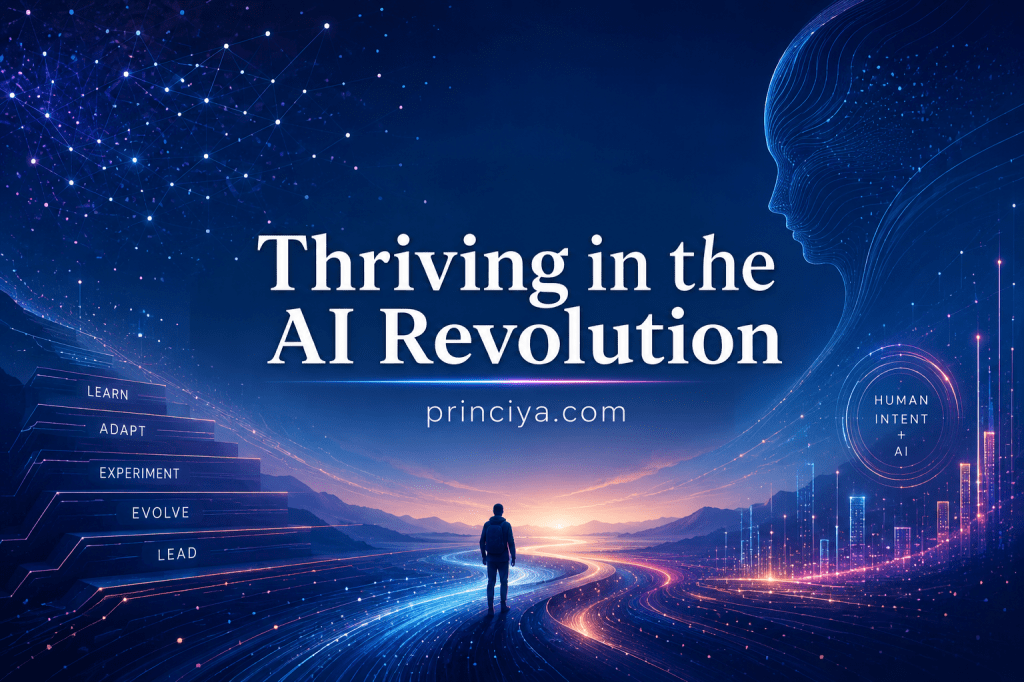
The Rapid Evolution of the AI Era
But somewhere between all this learning and building, I kept thinking about something else.
The real challenge of the AI era is not whether information is accessible. It is whether humans can sustainably keep up with the pace of change.
As an engineering manager and hiring manager, I have always considered learning ability to be the single most important skill. Technology changes. Architectures change. Frameworks change. But the ability to learn has always compounded over time.
What feels different now is the pace.
I think about it almost every day. What does this AI revolution actually mean for my role?mAm I worried? Maybe a little. Who does not want stability in their career and life?
But can I control the macro shifts happening across the industry? No! What I can control though is my intent, my adaptability, and my willingness to keep learning.
That distinction matters.
Top 3 Reflections from this Week
This week, apart from the hands on work, I also read three articles that deeply resonated with thoughts I have been carrying for months now. Thoughts I wanted to write about earlier but life happens, priorities shift, and time moves frighteningly fast.
It has almost been a month since my last post.
If you are new here, a quick recap. Last year I completed a 100+ day daily writing streak. One of the most rewarding things I have done for myself.
Somewhere during that journey, I realized writing was helping me process the AI transition in real time.
- Not just technically.
- Mentally.
- Professionally.
- Emotionally.
1. The Maintenance Trap in AI Era
The first article I read this week was Ethan Evans’ piece on avoiding the maintenance trap.
The article talks about how high performers slowly accumulate invisible maintenance burdens over time. Tech debt. System debt. Process debt. Cognitive overhead.
While reading it, I realized something.
The AI era has introduced an entirely new category of maintenance burden. Learning maintenance. The hidden pressure of continuously staying relevant.
Because unlike previous technology shifts, AI is not arriving in isolated waves. It is reshaping everything simultaneously. Engineering workflows. Product development. Search. Creativity. Leadership. Communication. Hiring. Knowledge work itself.
And if the underlying system, meaning us as humans, is not functioning well, AI stops becoming an amplifier and instead becomes friction.
I wrote previously using the Autobahn metaphor and also compared AI to tech’s migration toward cities. Both posts resonated strongly because they reflected what many of us are feeling right now.
- Acceleration.
- Congestion.
- Overstimulation.
- Movement at a scale that feels impossible to fully process.
The friction today is not just technical. It is human.
- How do you thrive in your day job while also investing enough time to learn and evolve?
- How do you stay calm while the ground underneath your role keeps shifting?
- How do you remain ambitious without mentally exhausting yourself trying to keep pace with everything?
That is the real maintenance trap.
2. How to Not Lose Your Job in 2027
The second article I read was Elena Verna’s provocatively titled post, You’ll Lose Your Job in 2027.
The title is obviously designed to grab attention.
But underneath the clickbait is an uncomfortable truth many of us quietly think about.
Roles are changing faster than job descriptions can keep up.
Personally, I do not know exactly what my role will evolve into over the next few years.
But I know standing still is not the answer.
I have always considered myself a hands on engineering manager. AI has now become this strange Swiss army knife sitting beside me every day. It helps me think faster, prototype faster, learn faster, and execute faster.
But at the same time, AI can also make it easy to lose sight of the human side of leadership. And that human side matters even more now.
Because leadership is increasingly becoming situational.
- Sometimes the problem needs technical depth.
- Sometimes it needs AI leverage.
- Sometimes it needs emotional intelligence.
- Sometimes it simply needs a calm human being who can help others navigate uncertainty.
That part cannot be ignored.
3. The Black Coffee Theory
The third article I came across discussed something called the Black Coffee Theory. One line from it stayed with me.
The world will deliver what you focus your energy towards.
In simple terms, if you cannot articulate what you want, eventually someone else will decide it for you.
That felt incredibly relevant to the AI era.
Because survival today is not just about technical skill. It is about intentionality. If you do not actively decide:
- what you enjoy,
- what you want to learn,
- where you want to evolve,
- what kind of problems energize you,
then it becomes very easy to drift. And drifting in times of massive technological change is dangerous.
The people who thrive in this era will probably not be the people who know every framework or every model release. It will be the people who can continuously learn, adapt, experiment, and evolve without losing themselves in the process.
Maybe that is the real definition of being future ready.
- Not certainty. But adaptability.
- Not fearlessness. But willingness.
- Not knowing all the answers. But continuously staying in motion.
And perhaps most importantly, protecting the human system underneath all of it.
Because even in the AI era, the bottleneck is still us.



Leave a Reply