
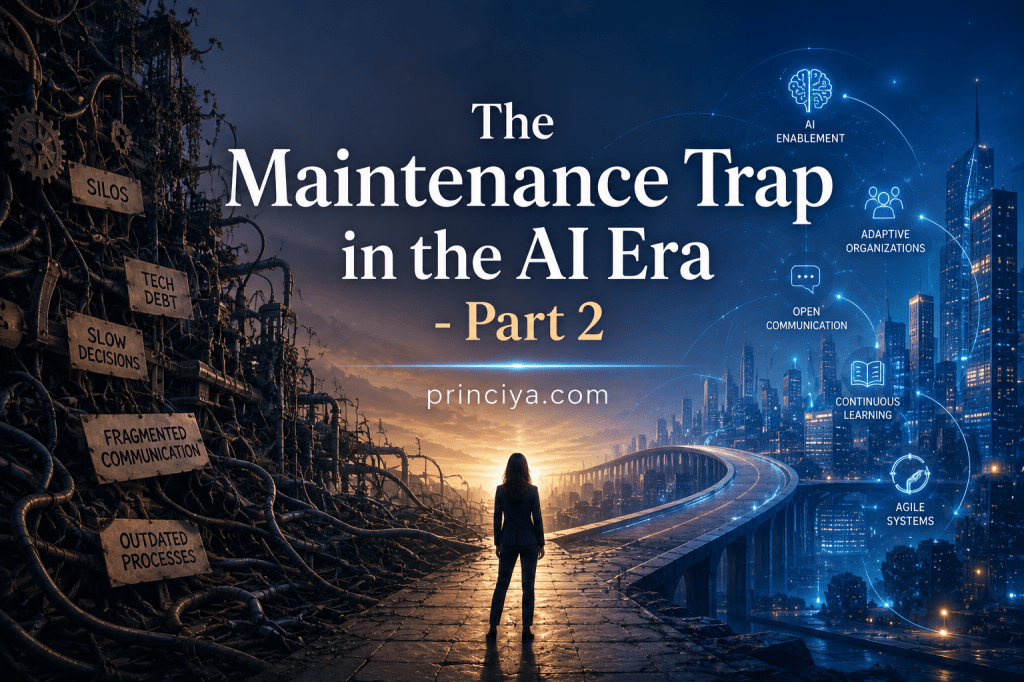
In my previous post, I wrote about the maintenance trap from an individual’s perspective.
The pressure to continuously learn.
The anxiety of staying relevant.
The challenge of balancing the day job while adapting to the AI era.
This challenge becomes exponentially harder at an organisational level. Because organisations are ultimately collections of human systems. And AI is testing those systems everywhere.
In this post, I will talk about the organisational challenges in the AI Era. I did write a post few months ago, which seems to be still relevant.
AI Does Not Transform Broken Systems
One thing feels increasingly clear. AI will not magically fix organisational inefficiencies. In many cases, it will amplify them.
The organisations that will evolve faster in the AI era are probably not just the ones with the best AI tooling or biggest budgets. They are the ones whose underlying systems were already healthy before AI arrived.
- How modern are their engineering practices?
- How fast can teams make decisions?
- How much operational friction exists?
- How collaborative are teams?
- How open is communication?
- How adaptable are leaders?
- How quickly can knowledge flow across the organisation?
These questions suddenly matter a lot more now. Because AI increases the pace of execution. And when pace increases, bottlenecks become painfully visible.
This reminds me a lot of scaling systems in engineering.
Under low traffic, inefficient systems somehow survive. Under high traffic, weaknesses become obvious very quickly.
AI is doing something similar to organisations.
It is stress testing culture, communication, decision making, and adaptability at scale.
The Real AI Transformation Is Organisational
A lot of AI conversations today focus on tools.
- Which model.
- Which framework.
- Which workflow.
- Which automation.
But the harder problem is organisational transformation. Because adopting AI is not an individual exercise. It is coordinated change management across an entire organisation.
And change management at scale is messy. Every individual enters this transition differently.
- Some people are excited.
- Some are anxious.
- Some are experimenting aggressively.
- Some are silently resisting.
- Some do not know where to begin.
This is where leadership becomes critical. Not leadership through hype. But leadership through clarity.
Communication Loops Become Critical
One thing I strongly believe organisations will need in the AI era is tighter communication loops.
- Not more meetings.
- Better communication.
- Clearer alignment.
- Faster feedback.
- More transparency.
- More context sharing.
- More learning visibility.
Because uncertainty grows in silence.
When communication is weak, people start creating their own assumptions about what AI means for their jobs, teams, and future.
That uncertainty eventually turns into resistance. Open communication matters now more than ever. Leaders do not need to have all the answers. Honestly, nobody does right now.
But leaders do need to create environments where people feel safe to:
learn, experiment, adapt, ask questions, and evolve.
That psychological safety is becoming a strategic advantage.
Organisational Design Will Evolve
I also think organisational structures themselves will evolve over the next few years. Not overnight. But gradually. The AI era is already changing: how teams collaborate, how quickly execution happens,
how much leverage individuals have, and how decisions get made.
A single engineer with strong AI workflows can suddenly operate with disproportionate impact. That changes team dynamics. Managers may spend less time coordinating execution and more time enabling adaptability.
Leaders may increasingly act as system designers instead of pure execution drivers. And organisations may slowly shift from rigid hierarchies toward more fluid, highly adaptive structures.
I do not think we fully understand what the end state looks like yet. But I do think the organisations that survive and thrive will be the ones willing to continuously redesign themselves.
- Not just technically.
- Culturally.
- Operationally.
- Humanly.
The Human System Still Matters Most
Ironically, the more AI advances, the more important the human layer becomes. Because technology adoption has never really been a technology problem.
It has always been a people problem.
- Trust.
- Fear.
- Communication.
- Motivation.
- Learning.
- Identity.
- Adaptability.
These are still the real variables underneath transformation. AI may accelerate execution. But humans still determine direction. And perhaps that is the real challenge for organisations in the AI era. Not simply adopting AI. But building human systems capable of evolving alongside it.



Leave a Reply